Ideal Height for Hanging Floating Shelves Above Bed

I’ll be honest — the first time I installed floating shelves above my bed, I overthought everything. I measured. I re-measured. I stared at the wall for two days. I even taped cardboard “fake shelves” up just to see how they felt.

Because here’s the thing: shelves above a bed are not like shelves over a desk. They sit over your head. Over the place you sleep. They need to look good, feel balanced, and most importantly — be safe.
After installing them in three different bedrooms (mine, a guest room, and my sister’s apartment), I’ve learned what works, what feels awkward, and what I would never do again. So if you’re wondering how high to hang floating shelves above your bed, here’s everything I’ve figured out from real-life experience.
The Height Sweet Spot (What Actually Works in Real Rooms)
Let me start with the measurement that has worked for me almost every time.
For a bed with a headboard, I hang the bottom of the shelf 16 to 20 inches above the top of the headboard.
That range feels natural. It doesn’t hover too low. It doesn’t float too high. It visually connects to the bed without crowding it.
If there’s no headboard, I measure 36 to 48 inches above the mattress surface. But I don’t stop there — I always test the seated height (more on that in a second).
The first time I installed shelves, I hung them only about 10 inches above the headboard because I thought I wanted that “tight designer look.” Big mistake. Every time I fluffed pillows or leaned back, I felt like the shelf was looming over me. It felt cramped. I ended up moving it.
After adjusting to 18 inches above the headboard, the whole wall suddenly felt balanced.
My Personal Safety Rule
Before drilling anything, I sit on the bed exactly how I normally would. Back straight, pillows behind me. Then I measure from the mattress to the top of my head.
Then I add at least 6 to 8 inches.
That number becomes my minimum clearance.
In my case, that usually means the bottom of the shelf ends up at least 22 to 24 inches above where my head reaches when sitting upright.
If you skip this step, you risk the awkward feeling of shelves hovering too close to your head. And trust me — once you notice it, you can’t un-notice it.
In my sister’s apartment, we initially forgot to account for her extra-thick pillows. She sat up, and her head nearly brushed the bottom of the shelf. We had to redo it. Lesson learned: measure with the pillows you actually use.
How Ceiling Height Changes Everything

When I installed shelves in my guest room with standard 8-foot ceilings, the 16–18 inch spacing above the headboard looked perfect.
But when I helped a friend in her 10-foot ceiling bedroom? Totally different story. The same measurement made the shelves look low and disconnected from the tall wall.
In higher ceilings, I’ve found I can push the shelf slightly higher — around 20 to 24 inches above the headboard — without losing visual balance.
Sometimes I even stack two shelves vertically. If I do that, I leave 12 to 15 inches between shelves. Any less and it feels cramped. Any more and they stop feeling related.
High ceilings let you be a little more dramatic. Lower ceilings demand restraint.
Shelf Depth: What I Learned the Hard Way
Height gets all the attention. Depth is what sneaks up on you.
In my first install, I bought shelves that were 10 inches deep because I thought, “More space is better.”
Wrong.
Above a bed, anything deeper than 8 inches starts to feel heavy. It visually leans over you. It makes the wall feel crowded.
Now I stick to:
- 6 inches deep for mostly decorative styling
- 8 inches deep if I’m storing books
Slim shelves look lighter and safer. And honestly, you don’t need much depth above a bed.
Bed Size and Proportion: What Looks Right
One thing I didn’t consider at first was how shelf width interacts with bed size.
In my queen bedroom, one long shelf that spanned about two-thirds of the bed width looked balanced.
When I helped style a king’s bedroom, that same shelf looked tiny. It visually shrank the bed.
Here’s what I’ve found works:
- King bed → Shelf at least 60–70% of bed width
- Queen bed → Medium-length shelf or two shorter symmetrical shelves
- Twin bed → One small centered shelf
Too small, and it looks accidental. Too big, and it overwhelms.
One Shelf vs Two (My Honest Take)

I personally love the look of one clean, centered shelf. It feels modern and calm.
But in my guest room, I installed two shelves stacked vertically because the wall felt tall and empty.
When stacking shelves, here’s what I do:
- Bottom shelf: 16–20 inches above headboard
- Second shelf: 12–15 inches above the first
Anything tighter feels crowded.
Also, I always tape out the layout first. Painter’s tape is your best friend. I tape the exact shelf dimensions onto the wall and live with it for a day. It saves so much regret.
Styling Without Making It Feel Unsafe
Here’s where restraint matters.
Above a bed, I never overload shelves. I’ve made that mistake. It turns cozy into cluttered fast.
Now I stick to:
- 2–3 framed pieces
- A small plant (nothing too tall)
- A short stack of books
- One sculptural object
I avoid:
- Heavy ceramics
- Glass near the edge
- Tall unstable decor
- Anything that could realistically fall
Because even if the shelf is secure, you don’t want to subconsciously worry about something dropping.
Mounting: I Don’t Cut Corners Anymore
This is the part where I get serious.
When something hangs above where I sleep, I don’t compromise.
I always:
- Mount into wall studs whenever possible
- Use heavy-duty toggle bolts if the studs aren’t aligned
- Avoid cheap plastic drywall anchors
- Check weight ratings carefully
The first shelf I ever installed? I used basic anchors because I didn’t know better. It held… but slightly tilted after a year. I replaced it properly.
Now I overbuild, not underbuild.
Special Situations I’ve Dealt With
No Headboard
When I styled a minimal platform bed with no headboard, the shelf initially looked too high because I measured only from the mattress.
I ended up placing it around 40 inches above the mattress, which visually framed the bed better.
Without a headboard, shelves need to visually “create” that frame.
Adjustable Bed
If your bed reclines, measure while it’s elevated. I helped install shelves in a room with an adjustable base, and we had to account for that tilt.
Better to hang slightly higher than risk contact.
Small Bedroom
In my sister’s small apartment, we skipped nightstands and installed two slim shelves on either side of the bed instead.
They sat slightly higher than typical nightstand height and doubled as bedside storage.
In small rooms, floating shelves can replace bulky furniture entirely.
What Actually Makes It Look Balanced
The right height doesn’t just come from measurements. It comes from how it feels visually.
After I hang a shelf, I always step across the room and squint.
Does the shelf connect to the bed?
Does it feel grounded?
Does it look like it belongs?
If it feels like it’s hovering randomly on the wall, it’s probably too high.
If it feels like it’s looming, it’s too low.
Balance is part math, part instinct.
Lighting and Mirrors
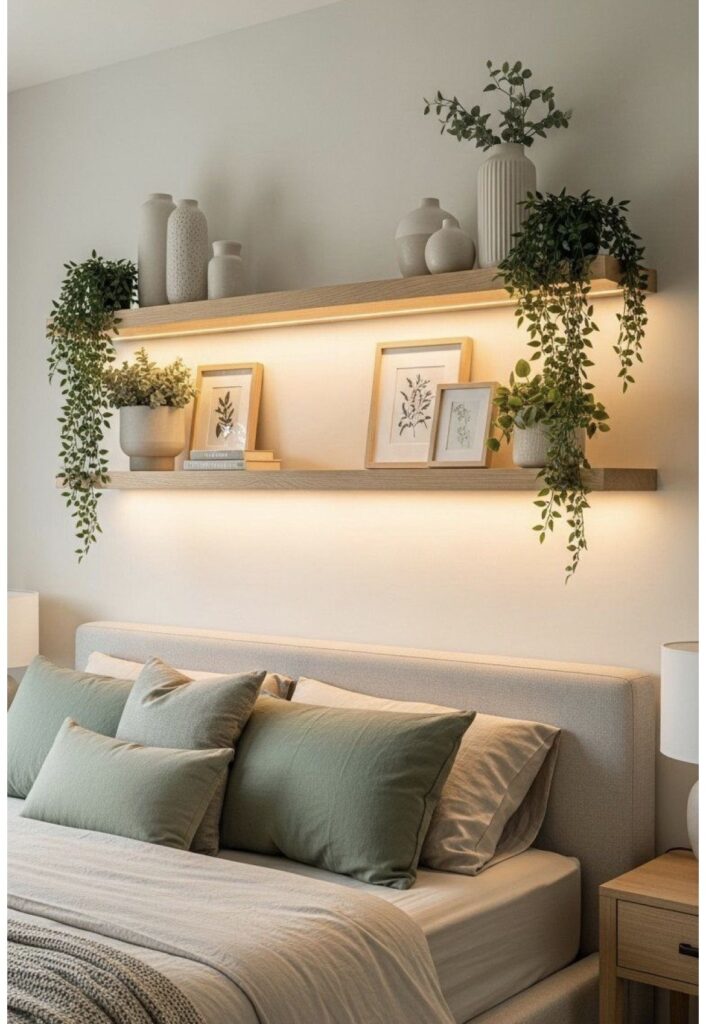
One trick I love: adding a small mirror or metallic frame on the shelf to reflect natural light.
But placement matters. If the shelf is too low, mirrors can reflect awkward angles.
I hang shelves high enough that reflected light feels soft, not glaring.
Light shelves on light walls also help small rooms feel larger.
My Personal Measurement Cheat Sheet
Here’s what I use every time now:
- 16–20 inches above the headboard
- 36–48 inches above mattress (no headboard)
- 22–24 inches minimum above seated head height
- 12–15 inches between stacked shelves
- 6–8 inches shelf depth
Those numbers haven’t failed me yet.
What I Would Never Do Again
After three installs, here’s what I avoid:
- Hanging shelves less than 12 inches above the headboard
- Using shelves deeper than 10 inches
- Ignoring seated head clearance
- Using cheap anchors
- Overcrowding decor
Every one of those led to either a redo or regret.
Final Thoughts From Someone Who Has Redone It Twice
Floating shelves above a bed are one of those design choices that look effortless — but only when the height is right.
For me, the magic number is around 18 inches above the headboard. It feels safe. It looks balanced. It gives enough space for styling without crowding the wall.
Measure carefully. Sit on your bed and test head clearance. Tape it out before drilling. Use strong hardware.
When done right, floating shelves make your bedroom feel intentional, layered, and beautifully finished.
And when you lie down at night and glance up at that styled shelf that sits perfectly in place?
It just feels right.